





























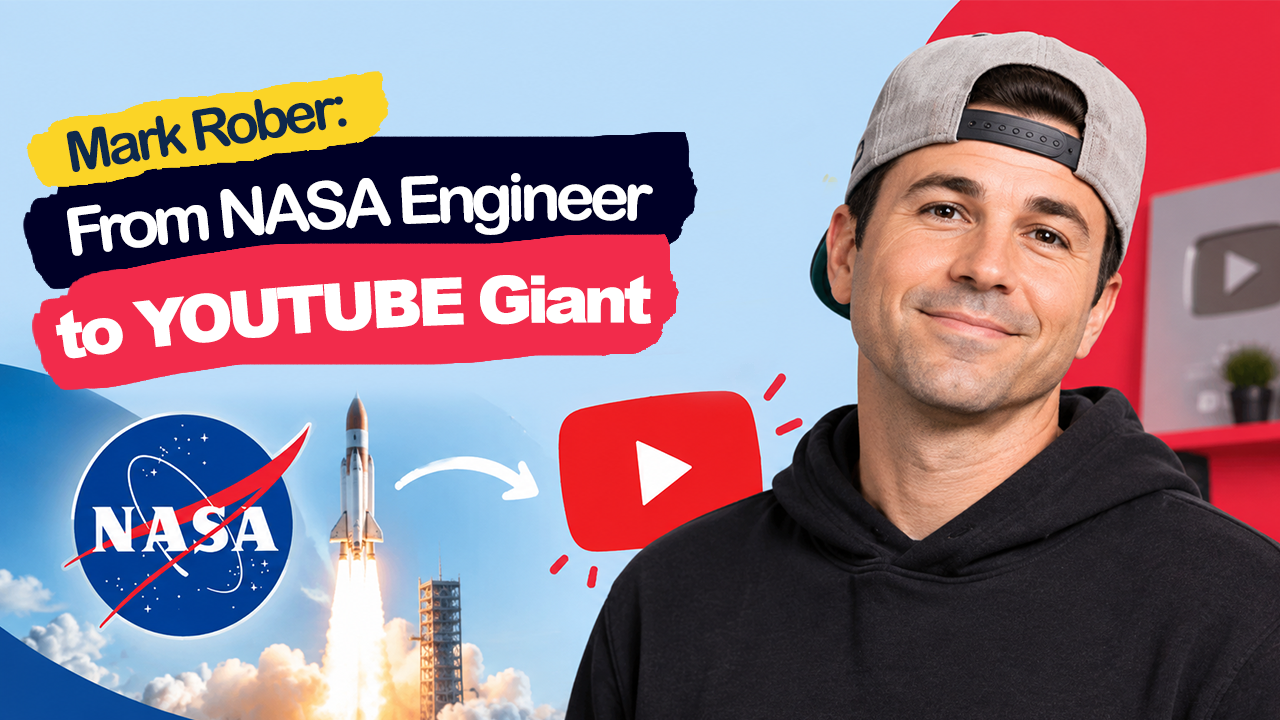
Mark Rober: From NASA engineer to YouTube giant

Even before YouTube was Mark Rober’s only world, he had already been involved in one of the most ambitious engineering projects on the planet. But it was not a big strategy that got him to start as a creator. It all started with an idea that couldn’t possibly be too crazy to shoot.
The Experiment That Started Everything
In 2011, while stationed with NASA’s Jet Propulsion Laboratory as an engineer, Rober posted a video of an iPad-fix-on-the-body Halloween costume that looked like a hole through his torso. The video went viral, clocking over a million views in just one day. Rober didn’t see it as a lucky viral moment, but an opportunity: people wanted to see him do things. That realization couldn’t help but drive him to continue his experiments. As a problem-solving engineer, he had previously tackled a lot of complex challenges, such as those related to NASA’s Curiosity Mars rover, but YouTube presented him with an entirely new kind of problem: How could complex ideas be made something millions of people would want to watch? This success also resulted in the creation of Digital Dudz, a company focused on “interactive Halloween costumes. Eventually he was able to sell the company and learn an early lesson in creating something larger than one piece of content from an idea on the web.
Finding the Formula Nobody Else Had
Rober’s channel started to go beyond just showcasing inventions and begin to add a purpose to the end of the video. His videos started when he took familiar problems and made them into big experiments. An obstacle course for squirrels turned into a competition. A science experiment turned into a show. A simple question might end up being a complex piece of equipment that includes various cameras and sensors and multiple efforts to get the right answer. The significant shift was in the way they told stories. Rober did not make any demands on the viewer’s engineering knowledge to click. The video, on the other hand, posed a question and provided an explanation throughout. That gave him the opportunity to find an out-of-the-box niche on YouTube. His videos might be of interest to those who love science, but they might also be of interest to someone who simply wanted to find out if a squirrel could jump through an obstacle course or if an outrageous idea actually worked. By this point, Rober was not only uploading experiments but he was actually working on his own. He was honing a familiar style.
Then Came the Glitter Bomb
That format resulted in the video which has become one of the highlights of his career, ‘Glitter Bomb 1.0 vs Porch Pirates’ back in December 2018. Disgusted by package theft, Rober developed a fake delivery package that contained glitter, cameras, and devices which would capture the thieves’ reactions. There was nothing conventional about the concept: it was visual, easy to grasp, so easy to spread beyond a typical science audience. The video was an instant success and went on to become a regular series, the Glitter Bomb. It made clear, most especially, that Rober could create a whole story around one thing that he had engineered: There could be a problem, a design process, an anticipation, a reveal and a pay-off. The original video has over 94 million views on YouTube. Rober also spoke about the reports that parts of the video were staged, stressing the importance of transparency with viewers on successful creator formats. Glitter Bomb was the beginning of the increase in the size of Rober’s projects. The greatest difference was that his audience was no longer just observing individual inventions. They were on a mission to follow Mark Rober.
YouTube evolved into an ecosystem
After he had developed this trust and attention, Rober started to use the audience for projects which went beyond entertainment. He was also part of MrBeast and hundreds of creators for the initiative to plant trees with #TeamTrees in 2019, raising over $24 million. It was two years later that #TeamSeas, a $30 million initiative to remove 30 million pounds of trash from oceans, rivers and beaches, came into the picture. Later, in 2022, Rober started CrunchLabs, where he applied his hands on engineering work to create real-world STEM solutions. Now the company has millions of boxes on the way and estimates that Rober has about 80 million subscribers on his YouTube channel. This growth is now spreading to education. In June 2026, YouTube announced that it would enter a partnership with Rober to create a new Grades 3-8 free science curriculum titled Class CrunchLabs, with hundreds of hands-on challenges and over 1,000 planned videos in 34 languages.
Final Thoughts
What’s interesting about Mark Rober’s YouTube journey is that the end goal wasn’t always clear when he first started. Experiments were a result of a Halloween costume. The experiments began to appear regularly. Glitter Bomb came out of that format. A successful channel then evolved into a platform for philanthropy, products and education. It’s not about making science entertaining; it’s about making science relatable. His more notable success was finding out what his viewers desired from him, then growing it without losing what made it special. He began by constructing things that people wanted to look at. Today he has created something much bigger; a creator brand, where the video, the business and the mission all begin with the same concept, curiosity and the desire to find out what comes next.
Related Posts